Cell Line Development – Limiting Dilution
Summary
- Cell line development requires production lines start from a single cell.
- We automated the cell counting, staining, dilution, and plating for a limiting dilution approach to achieve monclonality. This utilized:
- Integrated Vi-CELL XR Cell Viability Analyzer for automated cell counts
- Large volume mixing with 1200 μL capacity 96-channel head
- Integrated plate centrifugation for immediate imaging to confirm monoclonality
The aspect of cell line development that arguably adds the greatest challenge to the workflow is the need to derive cell lines from a single cell. This requirement drives the well throughput into the thousands when searching for the optimal expression clone. It also adds significant time to the process as cells require weeks to grow up to usable levels and cell viability is often reduced when plating at the single-cell level. There is also the challenge of isolating a single cell per well and there are a number of different routes to achieve this.
Limiting dilution is a traditional approach to achieve monoclonality. It entails diluting cells to the level that there is one cell on average per unit of volume plated in the wells. However, as predicted by the Poisson distribution, roughly one third of the plated wells will have zero cells, one third of wells will have a single cell, and one third will have multiple cells per well (Coller and Coller 1986). This inefficiency has driven the use of alternative technologies such as single cell printers or cell sorters which can deliver single cells in nearly all wells. However, the high cost of these cell sorting devices continues to drive the use of limiting dilution In addition, cells are often exposed to the non-sterile environments prior to introduction to the cell sorter, potentially leading to contamination, while the sorting process itself (pressure, time outside incubator, etc.) can impact cell viability.
Here we describe the automation of limiting dilution on a Biomek i7 Workstation (Figure 1) that overcomes a number of challenges associated with this workflow. Plate throughput was enabled through the use of storage devices such as labware feeders and the ability to integrate numerous devices can support automated analyses. The system used a HEPA-filtered enclosure to maintain a clean environment for cell manipulations and sterile pipette tips to further ensure sample sterility. This is of the utmost importance for this workflow as the cultures will be maintained for weeks, allowing sufficient time for any contamination to spread.
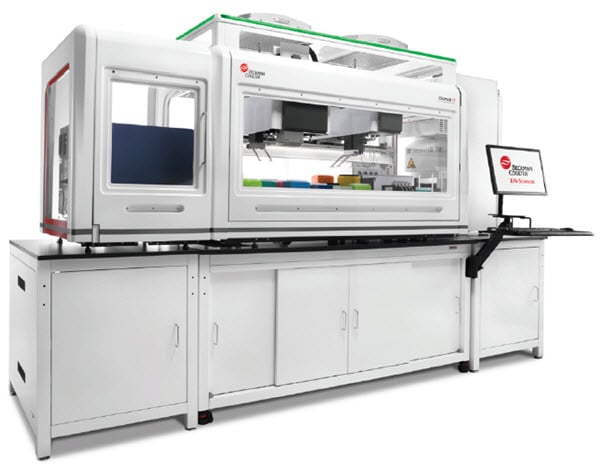
Figure 1. Biomek i7 Workstation with integrated devices to enable cell line development/cellular applications.

Figure 2. 1200μL-capacity multichannel head enables mixing large volumes for limiting dilution.
To create single cells colonies, the Biomek Workstation mixed and dispensed CHO cell suspensions to an integrated Vi-CELL XR Cell Viability Analyzer for counting. Based on the resulting cell count, ~83,300 cells were then transferred into 1mL 0.25 μM calcein AM and incubated at 37°C for 30 min. Following an initial 25-fold dilution, ~467 cells were added to a 140mL XP CHO Growth A media (Molecular Devices) such that there was one cell per 300 μL on average. Robust mixing and rapid filling of four 96-well plates was achieved through the ability to aspirate and dispense 96mL at one time with the 1200 μL-capacity multichannel head (Figure 2). Well A1 was then removed from the first plate and replaced with 300 μL of the intermediary dilution with 100X more cells to act as a control to optimize imaging focus and exposure time. Plates were spun in an integrated microplate centrifuge (Agilent) at 300 X g for 3 min to ensure any cells were at the plate bottom for immediate imaging on the CloneSelect Imager (Figure 3A, Molecular Devices). By eliminating the time for all cells to settle, we minimized the likelihood of early cell division and/or calcein stain efflux leading to false negatives.
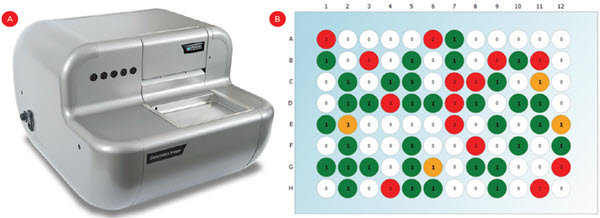
Figure 3. Monoclonality confirmation. A) A CloneSelect Imager was used to count fluorescent cells. B) A representative plate indicating empty wells (white), monoclonal wells (green/yellow) or wells with multiple cells (red). Yellow wells indicate confirmation is required due to faint signal or abnormal shapes which can indicate cell clusters.
Figure 3B shows the imaging results of a typical plate following automated limiting dilution plating. Monoclonal wells (green/yellow) are distinguished from those wells with zero (white) or multiple cells (red). To determine the sufficiency of mixing in the large-volume reservoir, we analyzed the frequency of monoclonality in each plate location across five experiments (20 wells).
Figure 4A shows the resulting distribution and no discernable location bias is detected. Inter-experiment consistency is demonstrated in Figure 4B, where the average frequency of monoclonal wells across the five experiments shows a narrow distribution (CV = 8.6%), at or near the expected frequency for a limiting dilution approach.
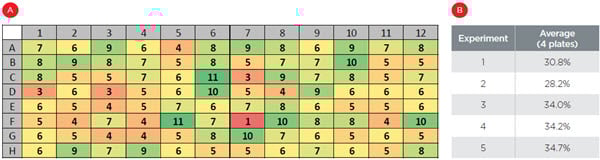
Figure 4. Consistent dilution and plating. A) Distribution of monoclonal wells across all five experiments with four plates each (20 wells per position). The conditional formatting highlights even mixing and distribution of cells in the large volume reservoir. B) Average monoclonality over four plates for each of 5 experiments illustrating consistency between experiments. The percentage of monoclonal wells approaches the expected distribution from limiting dilution.
While limiting dilution cannot achieve the efficiency of a cell sorting approach to monclonality, automating this plating and analysis as part of a larger automated cell line development system can reduce the effort needed to achieve the throughput required to identify optimal clones while also removing the need for additional costly tools.
References
Coller, H. A. & Coller, B. S. (1986) Poisson statistical analysis of repetitive subcloning by the limiting dilution technique as a way of assessing hybridoma monoclonality. Methods Enzymol, 121, 412-417. doi:10.1016/0076-6879(86)21039-3
Biomek Automated Workstations are not intended or validated for use in the diagnosis of disease or other conditions. Beckman Coulter Life Sciences genomic reagent kits are for research use only.
Helpful Links
-
Reading Material
-
Notes d'application
- 17-Marker, 18-Color Human Blood Phenotyping Made Easy with Flow Cytometry
- 21 CFR Part 11 Data Integrity for On-line WFI Instruments
- 8011+ Reporting Standards Feature and Synopsis
- Achieving Compliant Batch Release – Sterile Parenteral Quality Control
- Air Particle Monitoring ISO 21501-4 Impact
- An Analytical Revolution: Introducing the Next Generation Optima AUC
- Analyzing Mussel/Mollusk Propagation using the Multisizer 4e Coulter Counter
- Automated 3D Cell Culture and Screening by Imaging and Flow Cytometry
- Automated Cell Plating and Growth Assays
- Automated Cell Transfection and Reporter Gene Assay
- Automated Cord Blood Cell Viability and Concentration Measurements Using the Vi‑CELL XR
- Automated Genomic Sample Prep-Ampure XP PCR
- Automated Genomic Sample Prep-RNAdvance
- Automated Genomic Sample Prep-Sample Quality Control
- Automated salt-assisted liquid-liquid extraction
- Automated Sample Preparation for the Monitoring of Pharmaceutical and Illicit Drugs by LC-MS/MS
- Automated Transfection Methods
- Automated XTT Assay for Cell Viability Analysis
- Automating a Linear Density Gradient for Purification of a Protein:Ligand Complex
- Automating Biopharma Quality Control to Reduce Costs and Improve Data Integrity
- Automating Bradford Assays
- Automating Cell Line Development
- Automating Cell-Based Processes
- Automating the Cell Line Development Workflow
- The new Avanti J-15 Centrifuge Improves Sample Protection and Maximizes Sample Recovery
- The New Avanti J-15 Centrifuge Time Saving Deceleration Profile Improves Workflow Efficiency
- Avanti JXN Protein Purification Workflow
- Avoid the Pitfalls When Automating Cell Viability Counting for Biopharmaceutical Quality Control
- Beer, Evaluation of Final Product and Filtration Efficiency
- Biomek Automated Genomic Sample Prep Accelerates Research
- Biomek Automated NGS Solutions Accelerate Genomic Research
- Preparation and purification of carbon nanotubes using an ultracentrifuge and automatic dispensing apparatus, and analysis using an analytical centrifuge system
- Cell Counting Performance of Vi–Cell BLU Cell Viability Analyzer
- Cell Line Development – Data Handling
- Cell Line Development – Hit Picking
- Cell Line Development – Limiting Dilution
- Cell Line Development – Selection and Enrichment
- Changes to GMP Force Cleanroom Re-Classifications
- Characterizing Insulin as a Biopharmaceutical Using Analytical Ultracentrifugation
- Clean Cabinet Air Particle Evaluation
- Cleanroom Routine Environmental Monitoring – FDA Guidance on 21 CFR Part 11 Data Integrity
- Comparing Data Quality & Optical Resolution of the Next Generation Optima AUC to the Proven ProteomeLab on a Model Protein System
- Conducting the ISO 14644-3 Cleanroom Recovery Test with the MET ONE 3400
- Considerations of Cell Counting Analysis when using Different Types of Cells
- Consistent Cell Maintenance and Plating through Automation
- Control Standards and Method Recommendations for the LS 13 320 XR
- Counting Efficiency: MET ONE Air Particle Counters and Compliance to ISO-21501
- Critical Particle Size Distribution for Cement using Laser Diffraction
- CytoFLEX
- Detecting Moisture in Hydraulic Fluid, Oil and Fuels
- Determination of Size and Concentration of Particles in Oils
- Efficient kit-free nucleic acid isolation uses a combination of precipitation and centrifugation separation methods
- dsDNA Quantification with the Echo 525 Liquid Handler for Miniaturized Reaction Volumes, Reduced Sample Input, and Cost Savings
- Compensation Setup For High Content DURAClone Reagents
- Echo System-Enhanced SMART-Seq v2 for RNA Sequencing
- Efficient Factorial Optimization of Transfection Conditions
- Enhancing Vaccine Development and Production
- Enumeration And Size Distribution Of Yeast Cells In The Brewing Industry
- European Pharmacopoeia EP 2.2.44 and Total Organic Carbon
- Evaluation of Instrument to Instrument Performance of the Vi-CELL BLU Cell Viability Analyzer
- Exosome-Depleted FBS Using Beckman Coulter Centrifugation: The cost-effective, Consistent choice
- Flexible ELISA automation with the Biomek i5 Workstation
- Full Automation of the SISCAPA® Workflow using a Biomek NXP Laboratory Automation Workstation
- Fully-Automated Cellular Analysis by Flow Cytometry
- Get Control in GMP Environments
- g-Max: Added Capabilities to Beckman Coulter's versatile Ultracentrifuge Line
- Grading of nanocellulose using a centrifuge
- A method of grading nanoparticles using ultracentrifugation in order to determine the accurate particle diameter
- Grading of pigment ink and measurement of particle diameter using ultracentrifugation / dynamic light scattering
- HIAC Industrial – Our overview solution for fluid power testing for all applications
- HIAC PODS+ Online Mode & Filter Cart Mode
- HIAC PODS+ versus Parker ACM-20 Performance comparison
- A complete workflow for high-throughput isolation of DNA and RNA from FFPE samples using Formapure XL Total on the KingFisher™ Sample Purification System: an application for robust and scalable cancer research and biomarker discovery
- A Highly Consistent BCA Assay on Biomek i-Series
- A Highly Consistent Bradford Assay on Biomek i-Series
- A Highly Consistent Lowry Method on Biomek i-Series
- Highly Reproducible Automated Proteomics Sample Preparation on Biomek i-Series
- Cell Line Development – Hit Picking
- How to Use Violet Laser Side Scatter Detect Nanoparticle
- How Violet Side Scatter Enables Nanoparticle Detection
- HRLD Recommended Volume Setting
- Hydraulic Oil Measurement
- ICH Q2 – the Challenge of Measuring Total Organic Carbon in Modern Pharmaceutical Water Systems
- ICH Q2 – The Challenge of Measuring Total Organic Carbon in Modern Pharmaceutical Water Systems
- Importance of TOC measurement in WFI in light of European Pharmacopoeia change
- Temperature dependence of hydrodynamic radius of an intrinsically disordered protein measured in the Optima AUC analytical ultracentrifuge.
- Isolation of cell-free DNA (cfDNA) from plasma using Apostle MiniMax™ High Efficiency cfDNA Isolation kit— comparison of fully automated, semi-automated and manual workflow processing
- Issues with Testing Jet Fuels for Contamination
- Leveraging the Vi-CELL MetaFLEX for Monitoring Cell Metabolic Activity
- Linearity of BSA Using Absorbance & Interference Optics
- Long Life Lasers
- LS 13 320 XR: Sample Preparation - How to measure success
- Particle Size Analysis Simple, Effective and Precise
- Matching Cell Counts between Vi–CELL XR and Vi–CELL BLU
- MET ONE Sensor Verification
- Metal colloid purification and concentration using ultracentrifugation
- Separation and purification of metal nanorods using density gradient centrifugation
- Method for Determining Cell Type Parameter Adjustment to Match Legacy Vi CELL XR
- Minimal Sample to Sample Carry Over with the HIAC 8011+
- Minimizing process variability in the manufacturing of bottled drinking water
- Modern Trends in Non‐Viable Particle Monitoring during Aseptic Processing
- Multi-Wavelength Analytical Ultracentrifugation of Human Serum Albumin complexed with Porphyrin
- Particle diameter measurement of a nanoparticle composite - Using density gradient ultracentrifugation and dynamic light scattering
- What to do now that ACFTD is discontinued
- Optimizing the HIAC 8011+ Particle Counter for Analyzing Viscous Fluids
- Optimizing the Multisizer 4e Coutler Counter for use with Small Apertures
- Optimizing Workflow Efficiency of Cleanroom Routine Environmental Monitoring
- Particle Counting in Mining Applications
- Particle testing in cleanroom high-pressure gas lines to ISO 14644 made easy with the MET ONE 3400 gas calibrations
- Pharma Manufacturing Environmental Monitoring
- Pharma Manufacturing Paperless Monitoring
- Principles of Continuous Flow Centrifugation
- Protein purification workflow
- Background Subtraction
- Calibrating the QbD1200 TOC Analyzer
- Detection Limit
- Inorganic Carbon Removal
- JP SDBS Validation
- Method Overview
- Overload Recovery
- QbD1200 Preparing Reagent Solution
- USP System Suitability
- Quality Control Electronic Records for 21 CFR part 11 Compliance
- Using the Coulter Principle to Quantify Particles in an Electrolytic Solution for Copper Acid Plating
- RCC A standardized automated approach for exosome isolation and characterization
- RCC Avanti J 15 Series Maximizing Sample Protection and Sample Recovery
- RCC Avanti J 15 Series Time Savings and Workflow Efficiency
- Root Cause Investigations for Pharmaceutical Water Systems
- Scalable Plasmid Purification using CosMCPrep
- Specification Comparison of Vi–CELL XR and Vi–CELL BLU
- Specifying Non-Viable Particle Monitoring for Aseptic Processing
- A Standardized, Automated Approach For Exosome Isolation And Characterization Using Beckman Coulter Instrumentation
- Switching from Oil Testing to Water and back using the HIAC 8011+ and HIAC PODS+
- Advanced analysis of human T cell subsets on the CytoFLEX flow cytometer using a 13 color tube-based DURAClone dry reagent
- Using k-Factor to Compare Rotor Efficiency
- USP 787 Small Volume Testing
- Validation of On-line Total Organic Carbon Analysers for Release Testing Using ICH Q2
- Vaporized Hydrogen Peroxide Decontamination of Vi–CELL BLU Instrument
- Vi CELL BLU FAST Mode Option
- Vi-CELL BLU Regulatory Compliance - 21 CFR Part 11
- A workflow for medium-throughput isolation of cfDNA from plasma samples using Apostle MiniMax™ on the KingFisher™ Technology
- Brochures
- Catalogs
- Flyers
-
Posters
- Applications of Ultracentrifugation in Purification and Characterization of Biomolecules
- Automating Genomic DNA Extraction from Whole Blood and Serum with GenFind V3 on the Biomek i7 Hybrid Genomic Workstation
- ABRF 2019: Automated Genomic DNA Extraction from Large Volume Whole Blood
- AACR 2019: Isolation and Separation of DNA and RNA from a Single Tissue or Cell Culture Sample
- AACR 2019: Correlation between Mutations Found in FFPE Tumor Tissue and Paired cfDNA Samples
- AGBT 2019: A Scalable and Automatable Method for the Extraction of cfDNA
- ABRF 2019: Simultaneous DNA and RNA Extraction from Formalin-Fixed Paraffin Embedded (FFPE) Tissue
- AMP 2019: Correlation Between Mutations Found in FFPE Tumor Tissue and Paired cfDNA Samples
- Automated library preparation for the MCI Advantage Cancer Panel at Miami Cancer Institute utilizing the Beckman Coulter Biomek i5 Span-8 NGS Workstation
- Automating Cell Line Development for Biologics
- Cellular Challenges: Taking an Aim at Cancer
- Cell-Line Engineering
- Characterizing the Light-Scatter Sensitivity of the CytoFLEX Flow Cytometer
- ASHG 2019: Comparison between Mutation Profiles of Paired Whole Blood and cfDNA Samples
- ASHG 2019: Correlation Between Mutations Found in FFPE Tumor Tissue and Paired cfDNA Samples
- Mastering Cell Counting
- Preparing a CytoFLEX for Nanoscale Flow Cytometry
- A Prototype CytoFLEX for High-Sensitivity, Multiparametric Nanoparticle Analysis
- Product Instructions
- Protocols
-
Case Studies
- Adenoviral Vectors Preparation
- Algae Biofuel Production
- Autophagy
- B Cell Research
- Cardiovascular Disease Research
- Cell Marker Analysis
- Choosing a Tabletop Centrifuge
- Collagen Disease Treatment
- Controlling Immune Response
- Creating Therapeutic Agents
- DNA Extraction from FFPE Tissue
- English Safety Seminar
- Equipment Management
- Exosome Purification Separation
- Future of Fishing Immune Research
- Hematopoietic Tumor Cells
- iPS Cell Research
- Membrane Protein Purification X Ray Crystallography
- Organelles Simple Fractionation
- Particle Interaction
- Retinal Cell Regeneration
- Sedimentary Geology
- Severe Liver Disease Treatment
- Treating Cirrhosis
- University Equipment Management
- Fundamentals of Ultracentrifugal Virus Purification
-
Whitepapers
- Centrifugation is a complete workflow solution for protein purification and protein aggregation quantification
- AUC Insights - Analysis of Protein-Protein-Interactions by Analytical Ultracentrifugation
- AUC Insights - Assessing the quality of adeno-associated virus gene therapy vectors by sedimentation velocity analysis
- AUC Insights - Sample concentration in the Analytical Ultracentrifuge AUC and the relevance of AUC data for the mass of complexes, aggregation content and association constants
- Hydraulic Particle Counter Sample Preparation
- eBooks
- Interviews
-
Notes d'application